pymc.Beta#
- class pymc.Beta(name, *args, rng=None, dims=None, initval=None, observed=None, total_size=None, transform=UNSET, **kwargs)[source]#
Beta log-likelihood.
The pdf of this distribution is
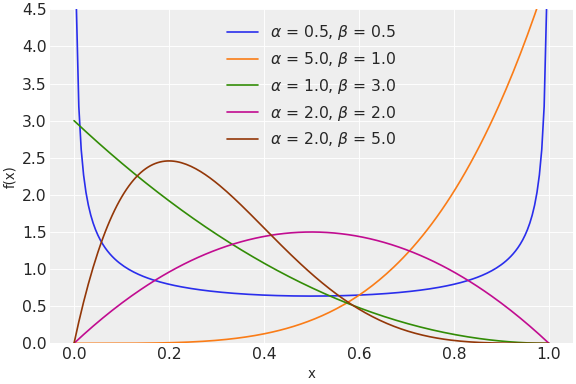
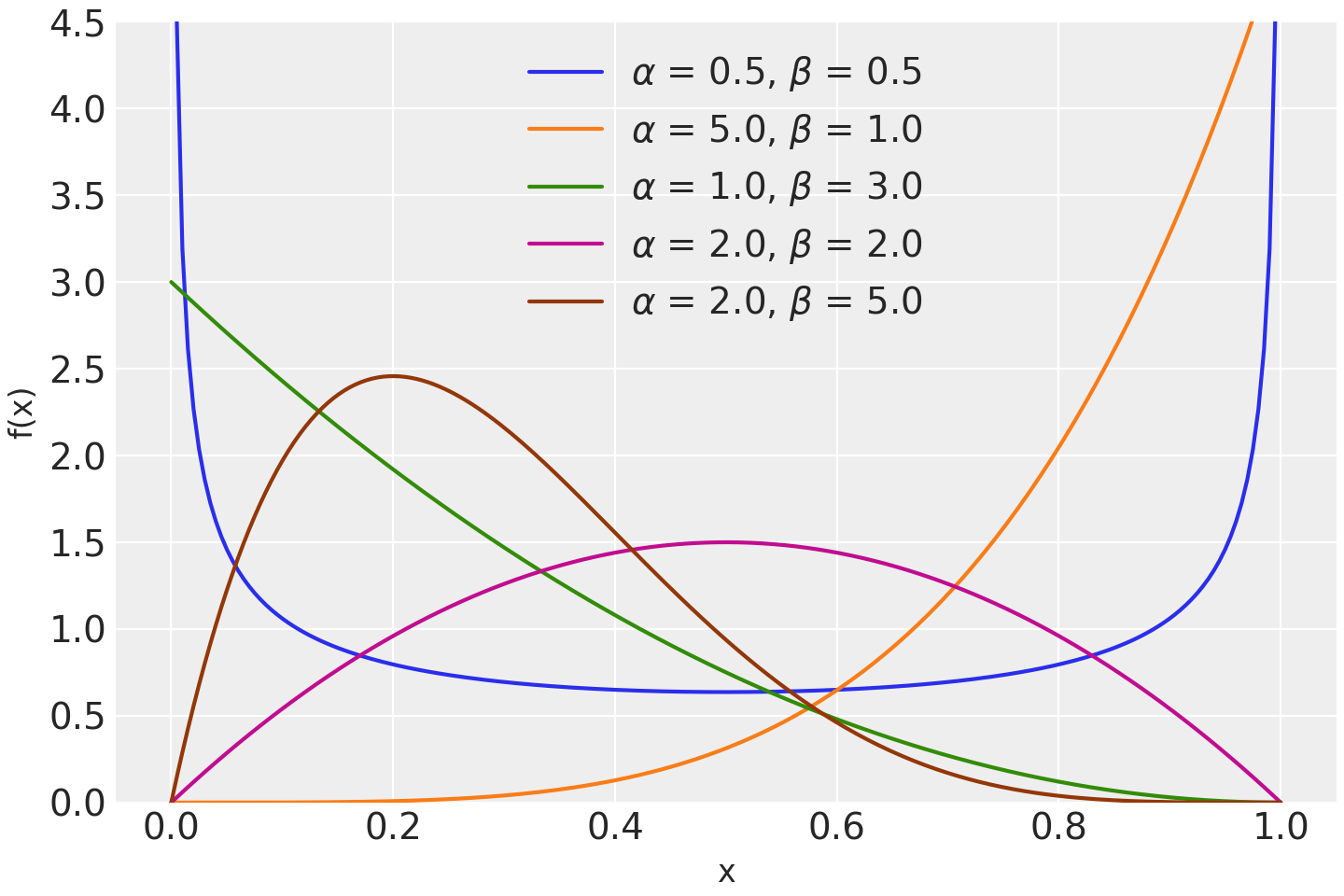
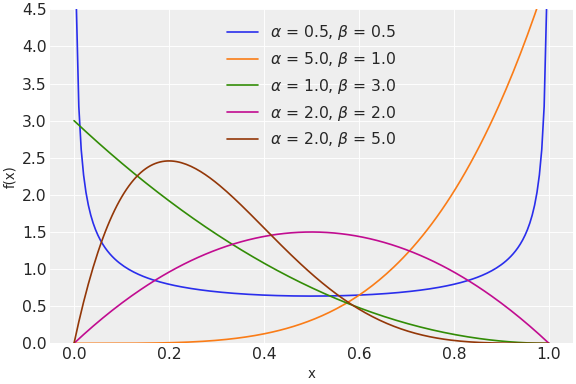
\[f(x \mid \alpha, \beta) = \frac{x^{\alpha - 1} (1 - x)^{\beta - 1}}{B(\alpha, \beta)}\](Source code, png, hires.png, pdf)
Support
\(x \in (0, 1)\)
Mean
\(\dfrac{\alpha}{\alpha + \beta}\)
Variance
\(\dfrac{\alpha \beta}{(\alpha+\beta)^2(\alpha+\beta+1)}\)
Beta distribution can be parameterized either in terms of alpha and beta or mean and standard deviation. The link between the two parametrizations is given by
\[ \begin{align}\begin{aligned}\begin{split}\alpha &= \mu \kappa \\ \beta &= (1 - \mu) \kappa\end{split}\\\text{where } \kappa = \frac{\mu(1-\mu)}{\sigma^2} - 1\end{aligned}\end{align} \]- Parameters
- alphatensor_like of
float, optional alpha> 0. If not specified, then calculated usingmuandsigma.- betatensor_like of
float, optional beta> 0. If not specified, then calculated usingmuandsigma.- mutensor_like of
float, optional Alternative mean (0 <
mu< 1).- sigmatensor_like of
float, optional Alternative standard deviation (1 <
sigma< sqrt(mu* (1 -mu))).
- alphatensor_like of
Notes
Beta distribution is a conjugate prior for the parameter \(p\) of the binomial distribution.
Methods
Beta.__init__(*args, **kwargs)Beta.dist([alpha, beta, mu, sigma])Creates a tensor variable corresponding to the cls distribution.
Beta.get_alpha_beta([alpha, beta, mu, sigma])Beta.logcdf(alpha, beta)Beta.moment(size, alpha, beta)Attributes
rv_op